
Despite our culture’s efforts in recent years to reverse the years of abuse and neglect Native American’s have suffered, there still remains misconceptions and misrepresentations of these people who settled this land long before there were settlers. There has been an attempt to even the scales, but the long standing stereotype of their beliefs and lifestyle remains tipped towards one of two images; the savage or the mystic. We have modified how we identify them, from Indian to American Indian to Indigenous People, but those two pictures still prevail. There have been scores of movies showing our abuses and revolutionary ideas written about by the likes of Howard Zinn and James Loewen have made the realities of enslavement and anthrax covered blankets commonplace in modern history books. New Age revivals from the sixties until today have shown their unique religious beliefs. Those roles still exist in our heads. The Native American is still a classic villain with a bazaar religion and acting as a mirror to the crimes of our past. Whether residue of centuries of guilt or genuine spirits trapped in their own prisons of emotions, there is a deep connection between the paranormal and Native American culture. This connection can be seen in the numerous reports of Native ghosts and the appearance of Native American ghosts and gods in legends.
Many hauntings fall into the realm of legend, and current reports as well as old folktales fall into basic motifs seen for over three hundred years. This does not invalidate reports as being untrue or merely a symptom of misunderstanding or fear. There is that element to them. Rather they help explain the possibilities of why these hauntings may be true. Deeper examination of these motif help to get a more complete picture of the relationship between settler and modern American to Native Americans.
The idea of the ancient burial ground often comes up in reports of ghosts in older times and modern days. The story is usually the same. Unexplained things happen in a house, most often poltergeist-like activity and odd dreams, and a deeper investigation reveals the house was built on an ancient Indian burial ground. The family is forced to leave the house or somehow expel the spirit or purify the land, which really means cleaning out the old to make room for the new. The concept is scary, the first essential element to a good ghost story. It invades our house where we are supposed to feel safe. Also included in this motif are instances where artifacts are removed and continue to curse or haunt those that take them, as well as dark tales of falling into a sacred land and being haunted or even killed by unseen forces.
It is important to note the wording of the phrase for it is always the same. Take the words “ancient” and “Indian”. “Ancient” allows us to see Native Americans as old, outdated and somehow mystic. The use of the word “Indian” helps paint a picture of the classic images of the people. Never is the more politically correct term used. “Cemetery” is never used in place of “burial ground”, creating a foreign feel that further serves to separate.
This concept has been seen in movies for years. It is interesting to note the modern day version of this tales where the American house is built on a cemetery like in the movie Poltergeist. The interesting aspect is that there are very few if any tales of this type of haunting in folklore until after Native American culture influenced European and American storytelling, although there is a rich tradition of falling into fairy circles and straying from the road into a haunted land.
Mary, a resident of Lexington, tells how her house became haunted by the spirits of “Indians” as she referred to them. She would hear chanting and find items in her house turned around facing the wall. After asking someone to investigate, she discovered her house was built on top of Native cemetery. She called upon a “witch doctor” to make the peace and her problems were promptly solved. She refused to watch the man clean the house and wanted no part of what he had done to help her. There is a Native cemetery in Rehoboth that has the reputation of being haunted. Dogs bark near the site at unseen people and travelers going by notice a dramatic change in their behavior and mood, even at night. There have also been reports of a shadowy figure walking through. In his book New England Ghost Files Charles Robinson describes a man from Middleboro who had his own experiences. The town uncovered an ancient site and went about digging it up. The town experienced unusual occurrences, but one man took a item he found on the site. He woke up to find a Native American ghost in his room and the next morning the item was gone.
The next motif involves attacks that occur on the coast or in lakes and ponds. These stories involve abductions, attacks or murders in a place people are already tentative about although they are places of recreation and enjoyment. Unseen hands drag someone under or tip over a boat. Children are seen and then disappear a moment later. Someone watches an old fashion canoe vanish. Afterwards the site is confirmed as being a location of tragedy, usually sparked by settler misdeeds. This motif is different from the others in that it sometimes extends beyond the spirits of people to include the gods of Native Americans. While a sacred land might be connected to a certain god or myth, the gods only consider the site sacred and therefore suitable to be used for burial. The human does the attacking. In contrast, it is the god who might attack people directly in the water, independent of the tension between Natives and the people attacked.
Any book on hauntings on the Cape and the Islands will reveal scores of tales involving Natives. Massachusetts lakes and ponds also have a high level of paranormal activity. A Westwood paper told the tale of Black Bear and his haunting of WigWam Pond in Dedham. Black Bear was a Native who tried to steal from a settler and was discovered and beaten. He returned later and tried to kidnap the man’s baby but was caught again. He was shot in the water trying to escape and jumped overboard rather than be caught. That part of the pond does not freeze over and cries have been heard there. Horn Pond in Woburn was the site of an ancient battle between the gods of light and dark. The gods of light trapped the bad guys there and then drown them. There have been multiple deaths in the pond through unexplained means. There is a rumor of tragedy in another pond in Lakeville. A branch has been seen being dragged across the water and people have heard voices and been hit, sometimes going as far as being touched on the leg and being dragged under.
Sexual tension and the rape of Native American women proves to be the spark of many hauntings, often becoming the root of water attacks, a certain buried spirit coming back or spectral lights. As settlers moved in they took a different perspective on the males and females they encountered. While males were a source of fear, native females represented sexual mystery and unattainable beauty, as well as objects of affection in a situation where women were not always available. The men took by force and the sexual attacks at times led to the eventual death of the woman. In other reports the woman kills herself rather than be disgraced or goes on living but becomes tainted or changed. While this is an excellent example of guilt in past behaviors, it is also a major aspect of paranormal activity. A rape and murder or suicide could produce enough negative energy to create a ghost.
One such case involves a Native woman who was sunbathing near a pond. Some local boys, angry at her attitude towards the settlers started to taunt her. She died while trying to get away from them and has stayed on at the pond. She has been credited with pushing people in the water and knocking boats over, sometimes trying to grab them and force them under once they are in. Her hand has been seen coming out of the water and some report to have heard her screams.
At times the relationship is consensual but the love is not allowed by one side’s culture. The lovers are kept apart. One or both might kill themselves or a misunderstanding may cause the death of one by the other’s people. It is a story as timeless and romantic as Romeo and Juliet and the numerous reports of old lovers seen at bridges or by the side of the road and widow balconies looking for their lover reveal this motif as still very much alive in the haunted sites of today. One such case is a bridge in Greenfield. A Native woman was in love with a settler and hung for trying to be with him. The bridge is still believe to be haunted by her ghost, although other aspects of the hauntings make it feel more like an urban legend. People entering the covered bridge can invoke the spirit by blinking there lights four times and honking there horn twice.
The last motif is the appearance of apparitions, seen as lights or orbs, in places of betrayal. This betrayal may be a battlefield or the site of a signing of a treaty gone bad, but it becomes tainted ground for Americans. Although there are some physical attacks at these sites, the bulk of the reports seem to be focused more on keeping the grave memory of what happened there alive. Full-bodied spirits are sometime seen looking lost or confused or reenacting the tragedy that happened. Whole battles are seen. Voices are heard or the sound of some action. Other times an unknown feeling overwhelms people in the area. They sense they are unwelcome and should leave the spot. People report feeling like they are being watched. Buildings constructed on the site burn down or suffer unexplained damage.
Two classic examples of this are seen in the southeastern part of the state. In Rehoboth there is Anawan Rock, the site of a surrender to the settlers that occurred during King Phillip’s War, considered by historians to be the most vicious war in American history. The settlers broke the treaty that was signed there causing more bloodshed. The forest near the rock has long been seen as haunted with dozens of reports, including lights, spectral Natives and drums. There has also been a voice heard threatening people in the forest that has been roughly translated into, “stand and fight.” In the Freetown State Forest the hauntings have a different feel. The land there was bought for short money and became a source of tension between Natives and settlers during King Phillip’s War. Today there is a reservation on the land, but that has not seemed to stem the tide of activity or violence the forest has become home to. In addition to suffering similar activity as Anawan Rock, the forest has become a magnet for violence. There have been several murders in the forest, most involving cult activity and even more bodies have been found dumped there. Cases of rape and assault were also common in last few decades there. One Wampanoag spokesman has been quoted as saying the violence there will not stop until the land is given back because the spirits in the forest and the ancestors of those robbed are unhappy and therefore restless.
Given the area and nature of the original settlers of New England, relationships between the societies were destined to create folklore and tales of spirits. Confusion, fear and miscommunications laid the groundwork for hostility and those hostilities flourished into traditions. Again, this does not validate the cynics who say paranormal activity is in the participants mind. Some of these tales, especially those that follow established folk motifs, may very well have never happened or originated in truth and then found themselves changed and manipulated by time. There is little doubt some of the hauntings out there are little more than cultural propaganda, but there are other reasons for the activity reported and for the survival of the legends.
Possible reasons come down to the two views of Natives; the savage and the mystic. The savage was someone to fear. Upon arriving in the Americas, Europeans form tentative alliances and relationships with the people they found. There began a sense of community, but I the backs of both side’s minds there remained an underlining fear of each other. Conversion and the desire for property brought this to light and sides began to form. Friends were now enemies and settlers began turning tribes who had alliances of their own against each other. This created a new need to see the enemy as an enemy. The land had to be cleaned for civilization and these people stood in their way. Details of attacks on settlers became exaggerated. Places were unsafe to go into because you may be attacked. These ideas and beliefs help to establish uniquely American folklore, giving people a sense of identity.
In a paranormal sense, these conflicts led to deep emotions that may still be replaying themselves. Anxiety and animosity are powerful feelings that are often associated with hauntings. People lived in fear and the abstract concepts became concrete in the form of strained relations and violence. Both the negative daily interacts and the killings on both sides led to deaths that still remain unresolved. It is not farfetched to see a spirit trapped by negative energy manifesting itself to the root of its imprisonment. Looking over the reports, most hauntings involve the killing or attack of a native or the invasion into sacred areas as the source of the activity.
Closely related to this is the native as mystic which formed the basis of some anxiety for the two groups as well as acted as ammunition in the propaganda war against one another. Their close religious relationship to the land around them was a source of confusion for settlers and possible trigger for activity. Settler could not fully understand the mysticism of the natives and this helped further isolate the two groups. It also led to the notion of conversion to a Christian belief set which invariably led to the idea that settlers were better and natives should be submissive. Religion also led to misunderstandings. Certain tribes did not understand the concept of ownership of land because of their religious beliefs and breaking legal agreements help escalate conflict. Certain rituals were seen as threats to settlers.
Native’s religion might be the source for actual hauntings as well. Their connection to spirits that they saw as very much active in their lives make them more likely to be sensitive to paranormal forces. They existence of ghosts is an integral part of their religion not in opposition to it. Whether their gods endowed them with certain powers after death can not be said, but it would at least make them open if that sort of thing is possible. At the very least, their deep religious connection with nature would prompt them to come back if they could to defend their land and seek revenge for promises broken.
There can be a debate on the nature of ghosts. An examination of hauntings over thousands of years reveals the same ghosts making their presence known in different places with different names. A vampire appearing in Romania starts to mirror one found in Rhode Island. This lends credibility to people who firmly state the paranormal should be seen as fiction, the recycling of folk beliefs passed off as fact. Science has yet to prove ghosts exist, although what evidence would cynics believe. Fact or fiction, Native Americans have played an important role in the paranormal history of this country. Examining haunted burial grounds and rivers, looking at the folklore passed down about the exploits of the savage, debating the truth and relationship of these separate disciplines, strengthens our identity.
Explore the darker side of Fort Myers with Christopher Balzano during the dark on a hauntingly unforgettable walking tour with True Tours.
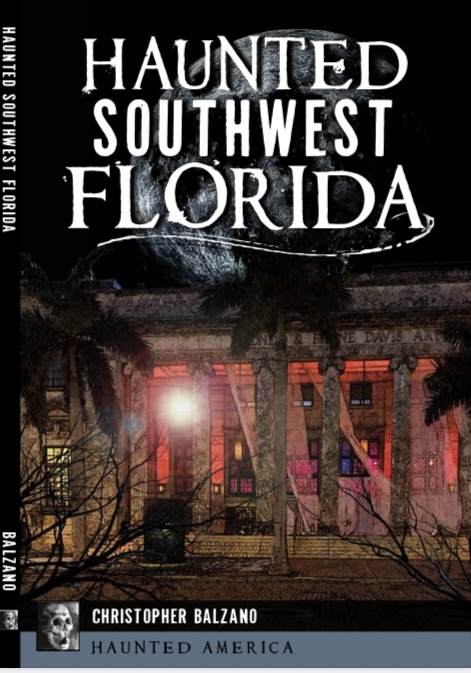
Check out Christopher Balzano’s books, including the newly released Haunted Southwest Florida.
Feel free to call our new phone number during our live shows to get involved, share a legend you’ve heard, or to just ask a question at (813) 418-6822.
www.facebook.com/trippingonlegends
Instagram: @SpookyTripping
You can contact us with questions, comments, and your favorite legend or tidbit of folklore at spookytripping@gmail.com.


 Tripping on Legends...
Leave a reply to Episode 26…Kiss My Astor – Tripping on Legends Cancel reply